
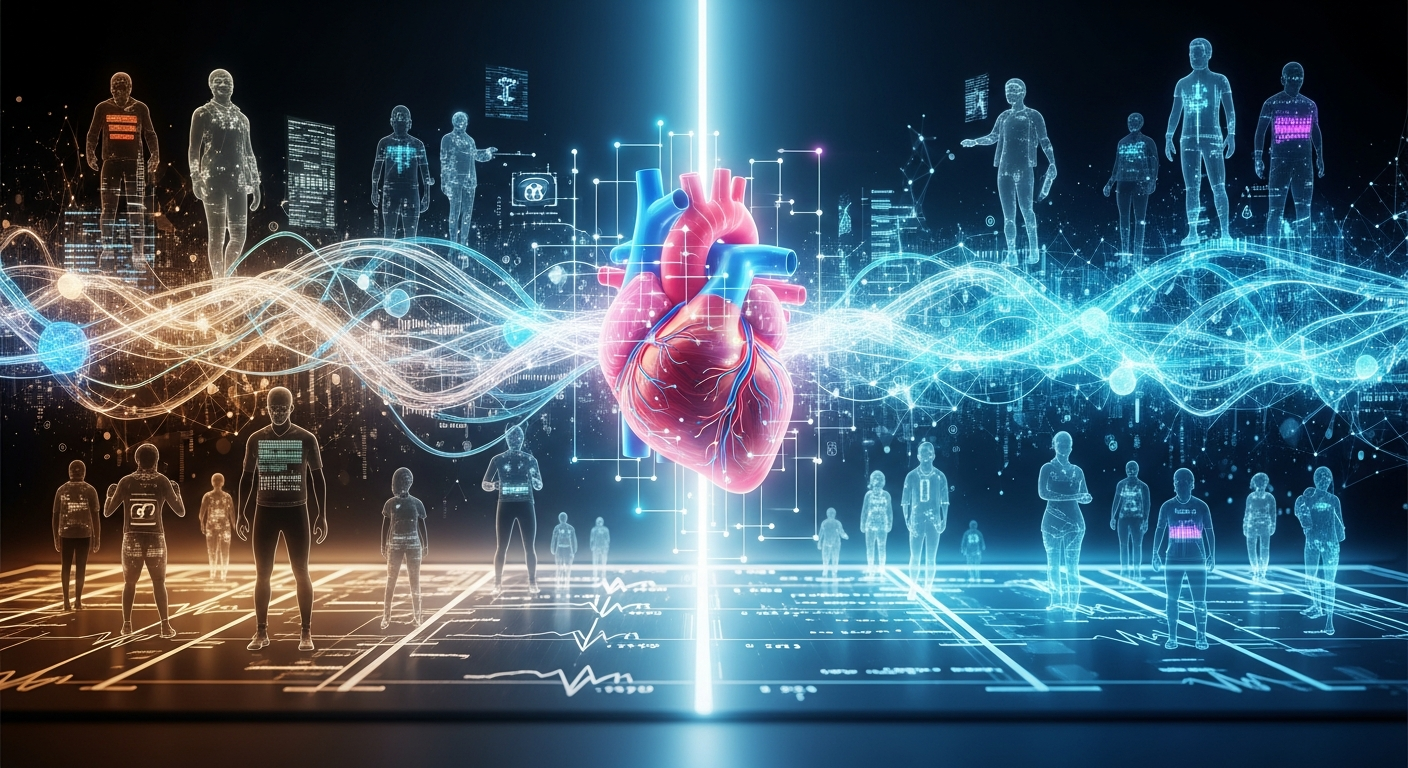
AIが心臓病リスク予測を塗り替える:個別化予防医療の新時代
For decades, predicting heart‑related events has felt like reading weather patterns through a fogged window. Doctors relied on broad risk categories, population‑level data, and imperfect indicators to estimate who might face a heart attack or stroke in the years ahead. It was a system built on averages, not individuals. But a quiet revolution is unfolding in clinics and research labs around the world, where artificial intelligence is beginning to sharpen that blurred picture into something startlingly precise.
AIがもたらす精密な予測
The promise of AI in cardiovascular care lies in its ability to see what humans cannot. Traditional models look at a handful of familiar factors—age, cholesterol, blood pressure, smoking history. AI‑driven tools, by contrast, can analyze thousands of variables at once, tracing subtle patterns across medical records, imaging scans, genetic markers, lifestyle data, and even the rhythms of daily life captured by wearable devices. What emerges is a portrait of risk that feels less like a guess and more like a forecast.
早期警告システムとしてのAI
Researchers describe these models as a new kind of early warning system. They can detect faint signals in the data—tiny irregularities in heart structure, shifts in metabolic markers, patterns in past medical history—that often go unnoticed in routine care. These signals, when woven together by machine‑learning algorithms, reveal trajectories that might otherwise remain hidden until it is too late. The goal is not to replace clinicians, but to give them a clearer map of the terrain ahead.
予防医療へのパラダイムシフト
What makes this moment transformative is the shift from reactive to proactive care. Instead of waiting for symptoms to appear, AI tools allow clinicians to identify high‑risk individuals long before danger becomes visible. Preventive strategies can be tailored with greater precision. Lifestyle interventions can be timed more effectively. Monitoring can become more focused and meaningful. The entire rhythm of cardiovascular care begins to change—from responding to crises to anticipating them.
AI導入における人間的側面と課題
Yet the rise of AI in heart‑health prediction is not just a technological story. It is a human one. Patients who once felt lost in the uncertainty of risk categories now receive insights that speak directly to their personal health journey. Clinicians gain confidence in their decisions, supported by models that learn from millions of data points. And health systems begin to imagine a future where fewer families face the sudden shock of a preventable cardiac event.
Still, this evolution brings its own challenges. AI models must be tested rigorously to ensure they work across diverse populations. They must be transparent enough for clinicians to trust their recommendations. And they must be integrated into care in ways that enhance, rather than complicate, the relationship between patient and provider. The technology is powerful, but its success depends on how thoughtfully it is used.
未来への展望
What is clear is that cardiovascular medicine is entering a new era—one where prediction becomes more personal, prevention becomes more precise, and the invisible risks of the heart become easier to see. AI is not just improving the tools of care; it is reshaping the very timeline of disease, shifting the focus from what has already happened to what might be prevented.
In this emerging landscape, the future of heart health feels less uncertain. It feels guided, illuminated, and full of possibility.
考察:AIが心臓病予防に与えるパラダイムシフトとその未来
AIによるリスク予測の精度向上と個別化医療の進展
AI技術の進化は、従来の曖昧なリスク評価から脱却し、個々の患者に合わせた精密な心血管疾患リスク予測を可能にしました。数千もの変数を同時に分析するAIの能力は、これまで見過ごされがちだった微細な兆候を捉え、より早期かつ正確なリスク評価を実現します。これにより、画一的な予防策ではなく、個々の患者の遺伝的背景、生活習慣、健康記録などを考慮した、真に個別化された予防医療が展開されるでしょう。これは、患者一人ひとりの健康ジャーニーに寄り添った、よりパーソナルな医療体験を創出する可能性を秘めています。
医療現場へのAI統合における倫理的・実務的課題
AIによる心臓病リスク予測の進展は目覚ましいものがありますが、その導入には慎重な検討が求められます。特に、AIモデルの多様な集団における有効性の検証、臨床現場での推奨事項に対する信頼性を確保するための透明性の確保、そして患者と医療従事者の関係性を強化する形でのAI統合は、技術的な課題だけでなく、倫理的・社会的な課題としても重要です。AIはあくまで「支援ツール」であり、最終的な意思決定は人間が行うべきであり、そのプロセスにおいてAIがどのように活用されるべきか、社会全体での議論が不可欠です。
予防医療の未来:危機対応から予測・予防へ
AIの導入は、心血管疾患ケアにおけるパラダイムシフトを加速させます。これまで、心臓病の治療は発症後の「危機対応」が中心でした。しかし、AIによる高リスク個人の早期特定と精密な予防介入により、その焦点は「予測・予防」へと大きくシフトします。これにより、予期せぬ心臓イベントによる家族への衝撃を減らし、より健康で活力に満ちた社会の実現に貢献することが期待されます。AIは、単に医療ツールを改善するだけでなく、病気の時間軸そのものを再構築し、より明るい未来を照らす可能性を秘めているのです。